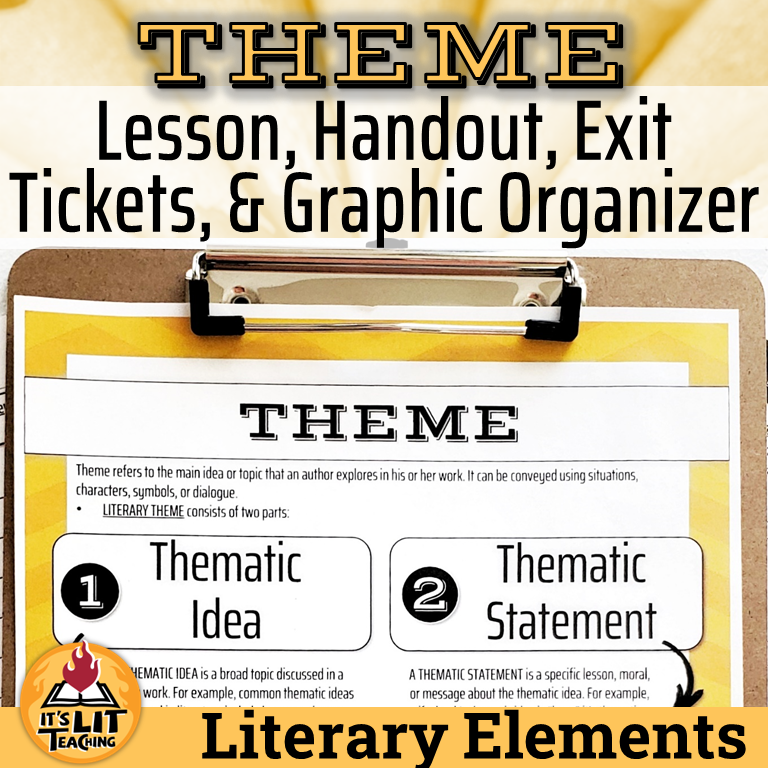
Although theme is a basic literary term, many high schoolers still struggle with it. Worse, so many students (and teachers!) get confused by thematic ideas versus thematic statements. Follow these steps for how to teach literary theme to high schoolers clearly!
(Want to skip the prep work? Grab my done-for-you Theme Lesson right here. You’ll get a lesson plan, slideshow, handout, exit tickets, and graphic organizer!)

Teach Literary Theme to High Schoolers Step #1: Assess Where Students Are Already
Like all good lessons, you should start with a pre-assessment. This does NOT need to be a long essay or rigorous test.
A simple “Who here has heard of theme?” or “What is theme?” is enough.
Start a simple conversation with your students and just ask them where they’re at. By the time your students get to you, most will have probably at least heard of theme. But even high schoolers often can’t analyze it in a text.
Start your lesson by activating their background knowledge and build from there.
Teach Literary Theme to High Schoolers Step #2: Give an Overview of Theme
Whether your entire class has heard of literary theme or the concept is completely new, you’ll want to start with a quick overview.
If you have students track literary terms, you could have them copy down the definition. Maybe you add “literary theme” to a word wall in your room.
But begin by giving them a definition and a broad overview.
Teach Literary Theme to High Schoolers Step #3: Teach the Difference Between Thematic Ideas and Thematic Statements
Once students have a general idea of what “theme” is in literature, continue breaking it down.
Most students will probably be familiar with thematic ideas. This is what I think most people think of when they try to brainstorm “literary themes.”
Keep your lesson loose and talk to your students. Can they think of any examples from popular movies or stories? What might a thematic idea be in Star Wars or The Hunger Games?

Thematic ideas will probably be easier for your students to both understand and determine. Students have to understand thematic ideas though before they can move on to thematic statements.
It’s good to show thematic ideas and statements side-by-side. For example, the thematic idea of “love” can have an infinite number of statements. A text might show that “love is the greatest gift of all” or that “true love doesn’t exist.”
Let them know that theme is one of those annoying concepts in English class that won’t have “one right answer.” A book will have many “correct” thematic ideas and statements.
Teach Literary Theme to High Schoolers Step #4: Demonstrate How to Write a Thematic Statement
Once you’ve thoroughly explained the differences between thematic ideas and thematic statements, be sure to give students tips on crafting a thematic statement.
For example, students should know that a thematic statement should be for the general population–not only applicable to a single, fictional character.
You might also want to have students avoid using cliches as their thematic statements but instead, word their statements more originally.

Teach Literary Theme to High Schoolers Step #5: Provide Plenty of Examples
As you progress through your lesson, you will of course want to provide plenty of examples.
Give examples of thematic ideas and statements. Challenge students to identify thematic ideas for their favorite movies, songs, or books. If you’re reading a class novel, give or ask students to think up examples from the book.
You can never give too many examples. Asking students to brainstorm their own will give them an opportunity for immediate feedback, too.
You might even want to provide bad examples, so students can see what NOT to do.
Plus, who doesn’t love discussing their favorite films? Talking about themes can be a great, relaxed lesson that allows relationship-building to occur at the same time as learning.
Teach Literary Theme to High Schoolers Step #6: Check In With Students’ Learning
As with all good lessons, find ways to assess as you go.
Discussing examples and talking about themes in students’ favorite works is a great way to assess informally. This might be all you need!
You could also use exit tickets after your lesson to see if students understood the basic concepts. I include two possible exit tickets in my Theme Lesson.
You don’t want to wait until students have to write a thematic essay to find out that students still don’t understand what a thematic statement is. Instead, be sure to check in with them consistently through your lesson or unit.

Teach Literary Theme to High Schoolers Step #7: Let Students Practice With a Short Text
Once you feel like students have a grasp on the concept of literary theme, it’s time for them to practice.
You can do this with any text, but I think songs work especially well. They’re a break from the usual classroom novels, drama, or poems. Plus, many will have music videos that add some multimedia to your lesson.
Choose a short text with a very clear message. There are tons of songs out there that try to make a point or express a single idea. Since these only have one thematic idea to analyze, they’re the perfect “training wheels” for those new to analyzing theme.
For example, Gloria Gaynor’s “I Will Survive” has a very clear theme/message for students to unpack. You can also choose something trendier, like a new Taylor Swift release or whatever is hitting the Top 20 chart that week.
Practicing Analysis
Once students have a copy of the text they are to analyze, challenge them to identify a thematic idea. This can be done as a class or individually. You may want to double-check that students identified a correct thematic idea before letting them move on.
After finding an idea, students should search for related passages. They can try to connect each one to the thematic idea or wait until they have several passages to begin their analysis.

For example, maybe students hone in on “dreams” as a thematic idea.
Next, students should identify lines, situations, characters, or symbols that relate to “dreams.”
From there, they would look at how each of these pieces of evidence is treated by the author. Are characters rewarded or punished for pursuing their dreams? Which characters are able to accomplish their dreams? Are dreams spoken of positively or negatively?
Then, students can try to craft a thematic statement. This will be the most difficult part for students. You may want to walk around offering assistance or just being a sounding board for student ideas.
It might be helpful to make sure all students are analyzing the same text the first time you have them analyze theme. Classroom conversations or discussions between peers will be easier. However, if you have more advanced students, you could let them choose their song or text to analyze instead.
A graphic organizer can help students track their thinking. My Literary Theme Lesson includes one that can be used with any text.
Teach Literary Theme to High Schoolers Step #8: Move on to More Difficult Analysis Activities
Once students have successfully analyzed thematic ideas and statements for a short text, they can move on to more difficult texts.
Analyzing a song with a singular message is great practice. But analyzing a novel with several complex themes and hundreds of pages will be harder.
You can scaffold between the two steps by providing students with the thematic ideas. This way, they will know what to look for as they read.
(I do this when I teach The Hate U Give and have students close read for themes. You can read more about my process for having students annotate themes in this blog post.)
Students can also use their new skills to write a full thematic analysis essay. You can check out my Born a Crime Thematic Essay assignment as an example.
Analyzing theme also makes for great classroom discussions, however. (I have a thematic discussion assignment for The Hate U Give, Dear Martin, and All American Boys.)
Gradually release responsibility to students. You can increase the difficulty in analyzing theme by giving students longer works to read. Another way to scale up the difficulty would be to give students older (and thus, more difficult to read) texts to analyze.
You could even have students write their own story that clearly conveys a theme! Having students write a children’s book would be a perfect way for them to do this.
Conclusion
Analyzing literary theme is an essential skill for students to master in Language Arts. There is often debate about whether to teach theme as one word or a statement. My answer is to do both.
Teach students about both thematic ideas and thematic statements. Provide examples. Give them the space and opportunity to explore these ideas in several texts.
Before you know it, they’ll be telling you the themes in movies they watch and books they read at home!
Need to teach literary theme to your high schoolers, but want to skip the prep? Grab my complete Literary Theme Lesson right here!