
When I became a high school teacher, I was SHOCKED at how many of my students wrote incomplete sentences. It took years for me to figure out the answer to this problem: teach clauses.
Teaching clauses helps students understand the relationship between nouns and verbs, subjects and predicates, and different parts of sentences. It gives them the vocabulary to understand why a sentence doesn’t work and to explain why it does.
In this post, I’m going to cover the steps to teaching clauses (or at least what worked for me).
If you want to save yourself a ton of time, you can grab my Clauses and Sentence Types Lesson, which dives deep into clauses, right here.

Teach Clauses Step #1: Make Sure Students Understand Subjects and Predicates
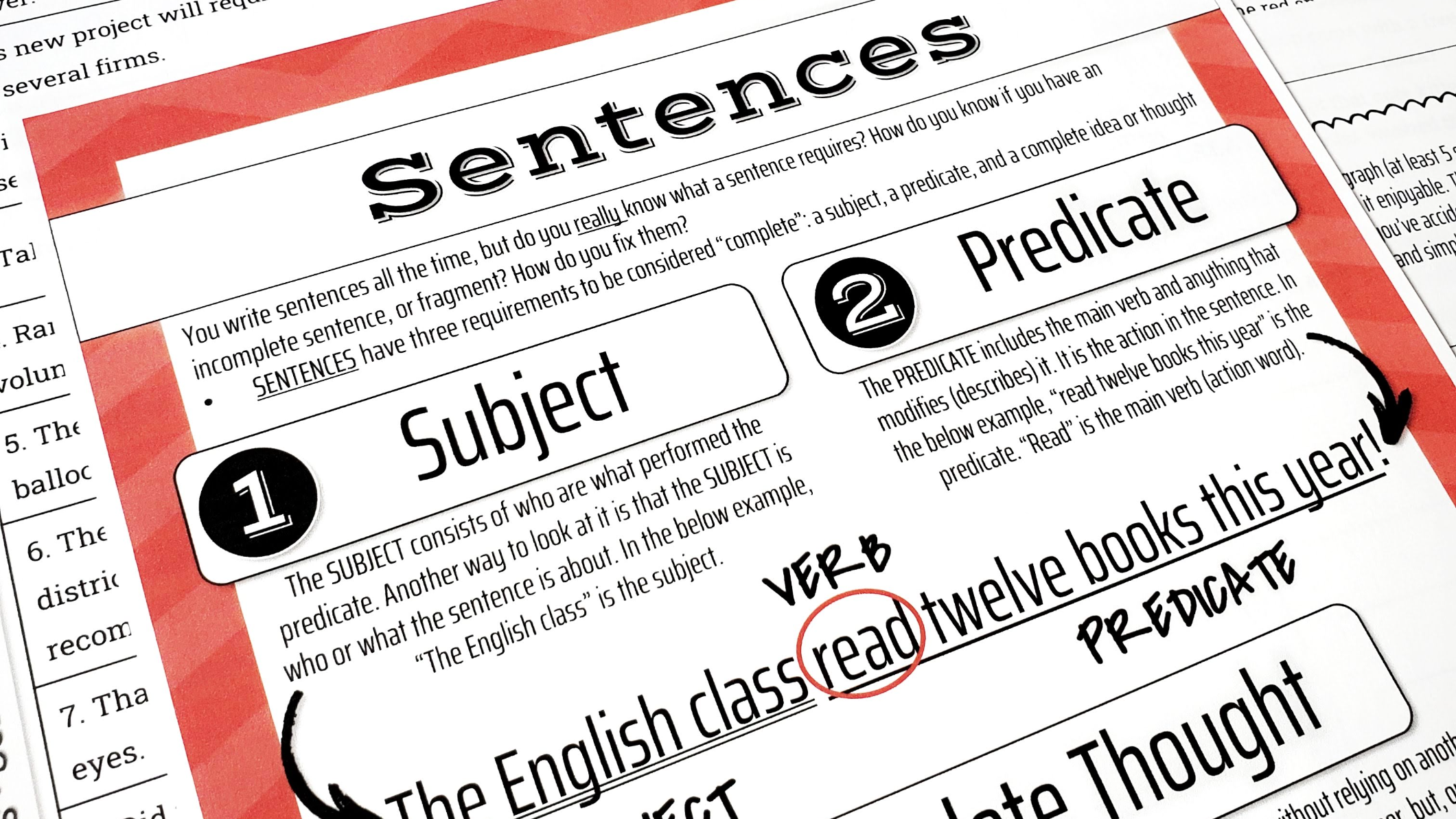
Before you can teach clauses, you need to make sure students understand subjects and predicates.

And before students can understand subjects and predicates, they need to understand nouns and verbs. Ouch.
I always recommend beginning your grammar unit or curriculum with some kind of assessment. This can be a test or a writing sample but know where your students are starting from.
Want some help figuring out where to begin? Check out this post about how to sequence your grammar instruction.
If you’re teaching high school, I do not recommend going all the way back to teaching all of the types of parts of speech. You’ll just lose too much time. Instead, do a quick recap of nouns and verbs.
Then, build up to subjects and predicates.
If you need a lesson that does all of this, my Parts of a Sentence Lesson reviews nouns and verbs before covering subjects and predicates.
Teach Clauses Step #2: Teach Independent Clauses and Simple Sentences
I like to teach clauses in tandem with teaching about different sentence structures.

Once students understand subjects and predicates, introduce the independent clause.
Emphasize the idea that an independent clause consists of one subject-predicate pairing. This will help simplify complicated sentences later.
Tell students that sentences with only one independent clause are called simple sentences. Give them some time to play around with simple sentences: have them identify the parts of the clause and write their own simple sentences.
Teach Clauses Step #3: Introduce Compound Sentences
Once students are comfortable with independent clauses and simple sentences, they can start combining independent clauses together.

Introduce coordinating conjunctions.
Be sure to emphasize that coordinating conjunctions must always be used with a comma. You’ll be repeating this rule again and again.
I like to use the acronym “fanboys” to help students remember all of the coordinating conjunctions: for, and, nor, but, or, yet, so.
You can grab a FREE coordinating conjunctions poster for your classroom right here!
Show students how coordinating conjunctions can be used to combine independent clauses. Then, give them plenty of practice opportunities. Let them identify the clauses and conjunctions in example sentences as well as write their own compound sentences.
Teach Clauses Step #4: Teach Dependent Clauses and Complex Sentences
Now comes the tricky part–dependent clauses.
Students can probably guess what dependent clauses are. If independent clauses can be sentences on their own, then dependent clauses can’t.
I like to take a second to review the definitions for “independent” and “dependent” at this point in class. It might help students remember the distinction between the two types of clauses.
Explain to students that, unlike independent clauses, dependent clauses can begin with many subordinating conjunctions like their favorite, “because.”
As you work through examples with students, be sure to point out the variety of subordinating conjunctions that exist.
Give students example sentences to break down. Have them identify the clauses and conjunctions. At this point, you can begin to mix up different sentence types and challenge students to identify the different types of clauses used and label the sentence types.

Teach Clauses Step #5: Cover Compound-Complex Sentences
Now you can introduce the last type of sentence structure: compound-complex.
In addition to showing students a different type of structure, examining compound-complex sentences gives students a chance to practice identifying more clauses.
Teach Clauses Step #6: Assess Student Understanding and Re-teach If Necessary

If you conducted a pre-assessment before teaching clauses, then you’ll need a post-assessment for after.
I have a simple 10-question, multiple-choice quiz here that assesses clauses and sentence types.
You could always make your own or ask for a specific writing sample that will show off your students’ new knowledge.
If your assessments show that students are still struggling, take the time to re-teach or review. It will be worth it in the end when you’re no longer reading fragments and run-on sentences!
Tips For Teaching Clauses
There are other types of clauses you can teach–like adverb, noun, or adjective clauses–but I like to stick to independent and dependent clauses.
These are the only two types of clauses students really need to know in order to later master punctuation. These clauses are also all that students need to know in order to avoid writing fragments or run-ons.
So unless you’re teaching a class of advanced students who all want to major in composition, I recommend teaching only the essentials and moving on.
Another tip is probably obvious, but you can never have too many examples. I think this is especially true with grammar.
Give students examples. Assign worksheets. Use grammar bell ringers. Put grammar on writing rubrics.
Don’t let grammar be separate from the rest of your curriculum, but instead make it a part of everything you do in your class.
Challenge your students to find one of each sentence type in their independent reading books. Make a game to see who can write the longest correct compound-complex sentence. During peer-editing activities, be sure students assess one another’s grammar.
Lastly, as difficult as this is, let this lesson take as long as it needs to be. When I taught clauses and sentence types, I spent one class period per sentence type and a fifth day to review.
It’s going to take a while to cover all of this material and give students enough practice. Teach a sentence type, do some practice, and then do something else the next day. Pick it up again a day or two later.
You can’t teach grammar topics in a day, so don’t expect them to go quickly.

Conclusion
Understanding clauses is a foundational skill for students’ grammar. If they understand them well, punctuation and writing interesting, varied sentences will be far easier later.
If students fail to understand them, well, get used to writing “frag” and “RO” over and over on all of your classroom essays.
Save yourself a ton of time by grabbing my Clauses and Sentence Types Lesson right here. It includes a slideshow, lesson plan, student worksheet, exit ticket, and more!